
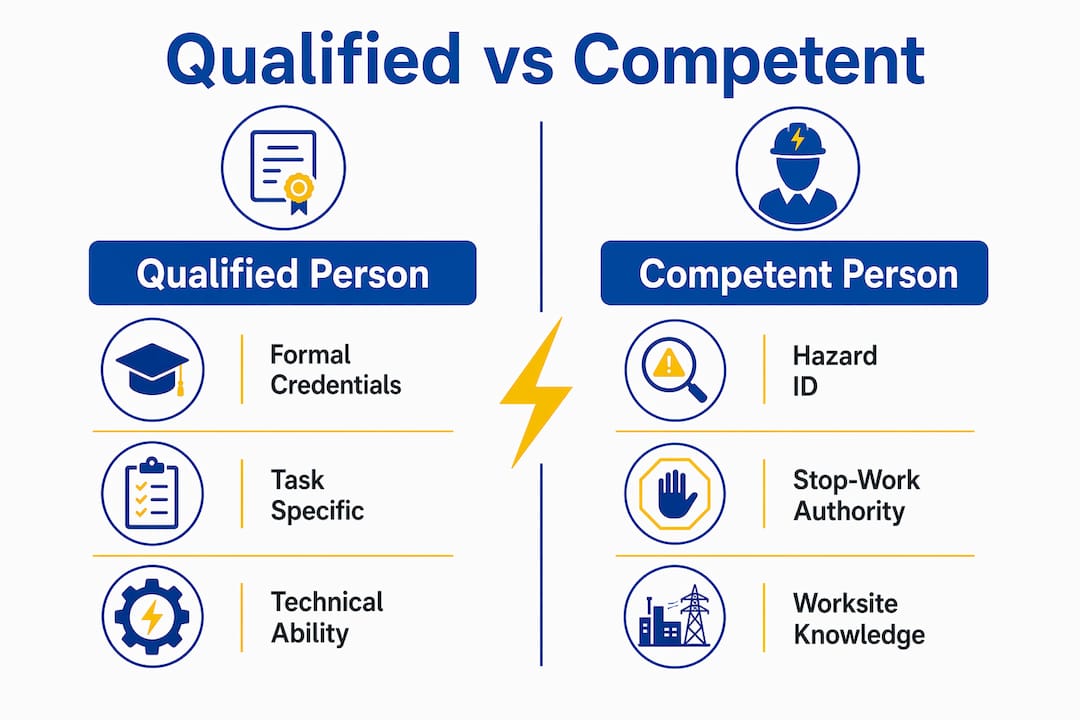
For electrical safety, a competent person is your on-site hazard-recognition and stop-work authority. A qualified person holds the formal technical credentials and demonstrated problem-solving ability to perform energized or complex electrical tasks. Under NFPA 70E and OSHA, these are two distinct designations with different documentation requirements, and mixing them up puts workers at risk and your organization on the wrong side of an inspection.
Here is what the distinction means in practice:
- A competent person can identify existing and predictable electrical hazards and has the authority to take corrective action immediately, including stopping work.
- A qualified person, by degree, certificate, or extensive training and experience, can solve or resolve technical problems related to the electrical work itself, such as troubleshooting an energized circuit or designing a protection scheme.
- A worker can hold both designations simultaneously, but each must be documented separately and tied to specific tasks.
Your immediate next step: draft a task-specific designation letter for each role and pair it with a training plan that maps to NFPA 70E requirements.
Table of Contents
- What do NFPA 70E and OSHA actually require from employers?
- How do a qualified person and a competent person actually compare?
- How do you evaluate, designate, and document each person?
- When is a competent person enough, and when do you need a qualified person?
- What training formats actually produce defensible competence and qualification?
- Key Takeaways
- The classification error that costs managers the most
- Arcflashtraining covers both designations, in the format that fits your site
- Useful sources for further reading
What do NFPA 70E and OSHA actually require from employers?
NFPA 70E sets the standard for safe electrical work practices in the U.S. and is the document OSHA compliance officers reference when investigating electrical incidents under 29 CFR 1910 (general industry) and 29 CFR 1926 (construction). NFPA 70E does not replace OSHA; it gives employers the technical framework OSHA expects them to follow.
The employer bears the burden of proof. If an inspector arrives after an arc flash incident, they will ask for training records, demonstrated-proficiency documentation, and the authorization chain showing who designated each worker and why. OSHA may directly question a designated person during an audit to verify their actual knowledge, not just their paperwork.
Employer responsibility under OSHA: The employer must designate competent and qualified persons, document the basis for each designation, and maintain records showing training completion, demonstrated skill, and the specific scope of authorization. Designation is not a title you hand out — it is a documented, defensible decision.
How do a qualified person and a competent person actually compare?
| Axis | Competent Person | Qualified Person |
|---|---|---|
| Definition | Capable of identifying existing and predictable hazards; authorized to take corrective action | Possesses degree, certificate, or extensive knowledge and experience to solve technical electrical problems |
| Primary authority | Stop-work, hazard correction, site inspection | Energized work, system troubleshooting, equipment design |
| Typical electrical tasks | Daily inspections, LOTO verification, hazard recognition | Energized troubleshooting, relay coordination, high-voltage switching |
| Required evidence | Training records, demonstrated hazard-ID ability, employer designation letter | Credentials (degree/cert), task-specific proficiency demonstration, scoped authorization |
| Scope limits | Task and site specific | Task-specific by equipment and voltage range |
Practical scenarios:
- Only competent: A maintenance tech who can spot a damaged conductor, tag it out, and stop work — but is not authorized to open an energized panel for troubleshooting.
- Only qualified: An electrical engineer who can design a protection scheme but has not been designated by the employer as the on-site hazard-correction authority.
- Both: A licensed journeyman electrician with employer designation, documented proficiency in energized work up to 480V, and explicit stop-work authority on the job site.
One detail managers often miss: qualification is frequently task-limited. A worker may be qualified to work on 480V motor control centers but not on 15kV switchgear. Your documentation must state those limits explicitly. Different OSHA standards, 29 CFR 1926 for construction versus 29 CFR 1910 for general industry, also treat definitions and allowed exceptions differently, so the standard that governs your work site matters.
How do you evaluate, designate, and document each person?
A defensible designation process follows these steps:
- Define the task scope first. List the specific equipment, voltage ranges, and permitted tasks before you assess anyone. Scope defines what you are qualifying or designating someone for.
- Review credentials and training records. For qualified persons, verify degrees, certificates, or documented extensive experience. For competent persons, confirm relevant training and prior hazard-ID experience.
- Conduct a practical proficiency demonstration. Course completion alone does not equal qualification. Have the worker demonstrate the skill on actual equipment or a representative mockup, and have an instructor or supervisor verify and sign off.
- Issue a task-specific designation letter. The letter should state the worker's name, the scope of authorization (equipment, voltage range, permitted tasks), the evidence reviewed, and the authorizing manager's signature.
- Store records in an audit-ready folder. Keep designation letters, assessment forms, training certificates, and the authorization chain together. These are the first documents OSHA and auditors request after an incident.
- Set reassessment triggers. Reassess annually at minimum, and also after any incident, near-miss, change in task scope, or introduction of new equipment.
Pro Tip: Use a two-page assessment form: page one captures credentials and training records; page two documents the practical demonstration with the evaluator's observations and sign-off. That format satisfies both the paper trail and the demonstrated-skill requirement in a single document.
When is a competent person enough, and when do you need a qualified person?
The dividing line is exposure to energized parts and the need for technical problem-solving.
- Competent person is sufficient: routine visual inspections, daily hazard walkthroughs, verifying that LOTO procedures have been applied correctly before work begins, and removing unsafe equipment from service.
- Qualified person is required: any work on or near energized electrical conductors or circuit parts, troubleshooting live circuits, performing an arc flash risk assessment, high-voltage switching operations, and relay or protection coordination.
- Misclassification consequences: sending a competent-only worker to troubleshoot an energized panel is an OSHA violation and a direct exposure risk. After an incident, if documentation shows the worker lacked the credentials or demonstrated proficiency for the task, the employer faces citations, potential willful-violation findings, and civil liability.
The OSHA construction standard 29 CFR 1926.32 defines a competent person as someone who can identify hazardous or dangerous conditions and has authorization to take prompt corrective measures. That definition does not extend to performing energized electrical work. Crossing that line without a qualified-person designation is where most compliance gaps occur.
What training formats actually produce defensible competence and qualification?

Managers often mistake course completion for qualification. Experts consistently flag this gap: documented demonstration of skill is required beyond sitting through a class, and the assessment should involve the actual equipment or a realistic mockup.
Format recommendations by designation:
- Onsite instructor-led training is the strongest option for producing qualified persons. Instructors can observe practical work, assess proficiency on real equipment, and sign off on demonstrated competence in the same session. It also lets you cover site-specific hazards and equipment.
- Live virtual instructor-led training works well for competent-person designation, especially for geographically dispersed teams or initial NFPA 70E awareness. Pair it with a site-based practical assessment to close the demonstration gap.
- Train-the-trainer programs make sense for large organizations running multi-site programs, where a certified internal trainer can conduct ongoing assessments and maintain records consistently.
When evaluating any training vendor, require CSP-credentialed instructors, written and practical evaluations, and audit-ready certificates that document what was assessed, not just what was attended. Arcflashtraining delivers all three formats, with CSP-credentialed instructors, task-specific assessments, and documentation packages built for OSHA audits. Their client base spans Fortune 500 manufacturers, utilities, data centers, healthcare systems, and construction firms, so the training content reflects real industrial environments, not generic scenarios. Electricians and electrical engineers who want to understand how formal credentials map to career-level qualifications will find that employer-documented proficiency is increasingly what separates candidates at the same license level.
Pro Tip: Ask any training vendor for a sample certificate and assessment form before booking. If the certificate only shows attendance hours and not the scope of tasks assessed, it will not satisfy an OSHA auditor asking for demonstrated-proficiency evidence.
Key Takeaways
A qualified person requires formal credentials and demonstrated technical ability for specific tasks; a competent person requires employer designation, hazard-recognition training, and documented stop-work authority — and both designations must be scoped, documented, and reassessed regularly.
| Point | Details |
|---|---|
| Designations are distinct | Competent covers hazard ID and stop-work authority; qualified covers energized and complex technical work. |
| Qualification is task-limited | Document the specific equipment, voltage range, and permitted tasks for each qualified person. |
| Employer bears the burden | Training records, proficiency demonstrations, and designation letters must be audit-ready before an incident occurs. |
| Reassess regularly | Reassess at least annually and after any incident, near-miss, or change in task scope or equipment. |
| Arcflashtraining delivers both | Onsite, virtual, and train-the-trainer formats with CSP-credentialed instructors and audit-ready documentation for competent and qualified designations. |
The classification error that costs managers the most
Most misclassification problems do not start with ignorance of the definitions. They start with a manager who knows the difference but skips the documentation step because the worker "obviously knows what they're doing." That gap, between acknowledged competence and documented competence, is exactly where OSHA citations land.
Two changes you can make this week: add a task-specific designation letter to every energized-work authorization, and require a short practical assessment before any worker is cleared for qualified-person tasks. Neither takes more than a day to implement, and both dramatically change your exposure in an audit or incident investigation.
The other common misstep is treating qualification as permanent. A worker qualified on one generation of switchgear may not be qualified on a newer system with different protection logic. Scope limits in your documentation are not bureaucratic overhead. They are the mechanism that keeps the designation accurate over time.
Arcflashtraining covers both designations, in the format that fits your site
If your team needs NFPA 70E training that produces defensible competent and qualified designations, not just attendance certificates, Arcflashtraining delivers exactly that. Every session, whether onsite at your facility or through a live virtual course, is led by CSP-credentialed instructors and includes written and practical assessments with audit-ready documentation.
Formats include onsite group training, live virtual instructor-led sessions, custom multi-site programs, and train-the-trainer delivery for organizations that need internal assessment capability. Every program is built around NFPA 70E and OSHA compliance requirements, with documentation packages that hold up when an auditor asks for proof.
Request a quote or schedule your session at arcflashtraining.org.
Useful sources for further reading
- OSHA 29 CFR 1926.32 — The OSHA construction standard definition of "competent person." Save this to your audit folder as the primary regulatory reference for construction-site designations.
- SHRM: OSHA Competent and Qualified Are Not the Same — Practical breakdown of the distinction with employer burden-of-proof guidance. Useful for drafting designation letters and training plans.
- Safety+Health Magazine: 'Competent,' 'qualified' — and more — Expert commentary on the definitions and the common error of treating course completion as qualification.
- OSHA Standard Interpretation (1986) — Historical enforcement guidance confirming that OSHA inspectors may directly verify a designated person's knowledge during audits.
- Arcflashtraining: NFPA 70E Training and Certification — Service overview covering onsite, virtual, multi-site, and train-the-trainer formats with CSP-credentialed instructors and audit-ready documentation.