
The single most important action you can take right now is to commission or update an arc-flash study, verify your lockout/tagout (LOTO) program covers every energy source in the facility, and get your qualified persons through documented NFPA 70E training. Those three moves address the highest-consequence risks under NFPA 70E, OSHA 29 CFR 1910.147, and 1910.331–335, and they form the foundation of every defensible electrical-safety program in a data center.
Here is where to start, in priority order:
- Commission or update your arc-flash study. If it is more than five years old or the electrical system has changed, it is out of date.
- Audit your LOTO program. Confirm written procedures exist for every piece of multi-energy equipment: UPS systems, automatic transfer switches (ATS), CRAH/CRAC units, and generators.
- Install engineering controls. Closed-panel voltage verification, permanent test points, and remote racking reduce worker exposure before PPE enters the equation.
- Deploy condition-based monitoring. Thermal imaging windows, permanent temperature indicators, and vibration sensors catch faults that scheduled inspections miss.
- Align PPE to incident-energy results. PPE categories must come from the arc-flash study, not from guesswork or generic tables.
- Establish a training cadence. Initial qualification, annual refresher, and task-specific training for every qualified person, with audit-ready records.
- Document everything. Studies, training rosters, LOTO procedures, inspection logs, and energized-work permits must be audit-ready at all times.
Pro Tip: Commission the arc-flash study first. Every other decision, from PPE category to energized-work permit thresholds, flows from the incident-energy results it produces.
Table of Contents
- What engineering controls should you prioritize to reduce worker exposure?
- What does an arc-flash study cover, and how often should you update it?
- How do you select PPE and avoid overreliance on it?
- What maintenance and inspection practices prevent electrical failures?
- Which U.S. standards and regulations apply to data center electrical safety?
- How do you define 'qualified persons' and build a training program?
- How do LOTO, energized-work permits, and pre-job planning work in practice?
- Why are engineering controls and continuous monitoring now non-negotiable?
- A 90/180/365-day implementation checklist for your electrical-safety program
- Key Takeaways
- A trainer's honest take on where data center programs actually fail
- Arcflashtraining brings NFPA 70E compliance to your data center team
- Authoritative sources and further reading
What engineering controls should you prioritize to reduce worker exposure?
PPE is the last line of defense, not the first. The NFPA 70E hierarchy of risk controls places elimination and engineering controls above PPE, and in a data center, that distinction has real consequences. High-density power infrastructure means fault energy levels that can exceed what any PPE category is rated to handle.
The controls that deliver the most exposure reduction in data center environments:
- Closed-panel voltage verification. Permanently installed voltage indicators (such as Wiggy-style panel-mounted indicators or dedicated test points) let technicians confirm live or dead status without opening a panel. No open panel means no arc-flash boundary exposure.
- Permanent thermal monitoring windows. Infrared-transparent viewports installed on switchgear and PDU enclosures allow thermal scans under load without removing covers. Closed-panel IR windows eliminate the single most dangerous step in a traditional thermal inspection.
- Remote racking and switching. Remote racking devices let workers rack breakers in or out from outside the arc-flash boundary. Remote switching via building management systems or switchgear with motorized operators removes the human from the fault zone entirely.
- Arc-resistant switchgear. For new builds or major switchgear replacements, arc-resistant equipment redirects fault energy away from the worker. The cost premium is significant, but so is the exposure reduction.
- Permanent temperature indicators. Devices like Graceport panel-mount indicators provide continuous temperature data without any panel access, supporting condition-based monitoring between formal thermal surveys.
Each of these controls reduces the probability that a worker is present when a fault occurs, or reduces the energy they are exposed to if they are. That is a fundamentally different risk posture than relying on a technician to wear the right PPE correctly every single time.
Pro Tip: In a retrofit, start with high-risk asset mapping. Identify the three to five pieces of switchgear or distribution equipment with the highest incident-energy values from your arc-flash study. Install closed-panel IR windows and permanent test points on those assets first. New builds should specify arc-resistant switchgear and remote racking as standard.

What does an arc-flash study cover, and how often should you update it?
An arc-flash study, formally called an incident-energy analysis, is the technical foundation of your entire electrical-safety program. Without current study results, PPE categories are guesses and energized-work permits lack a defensible basis.
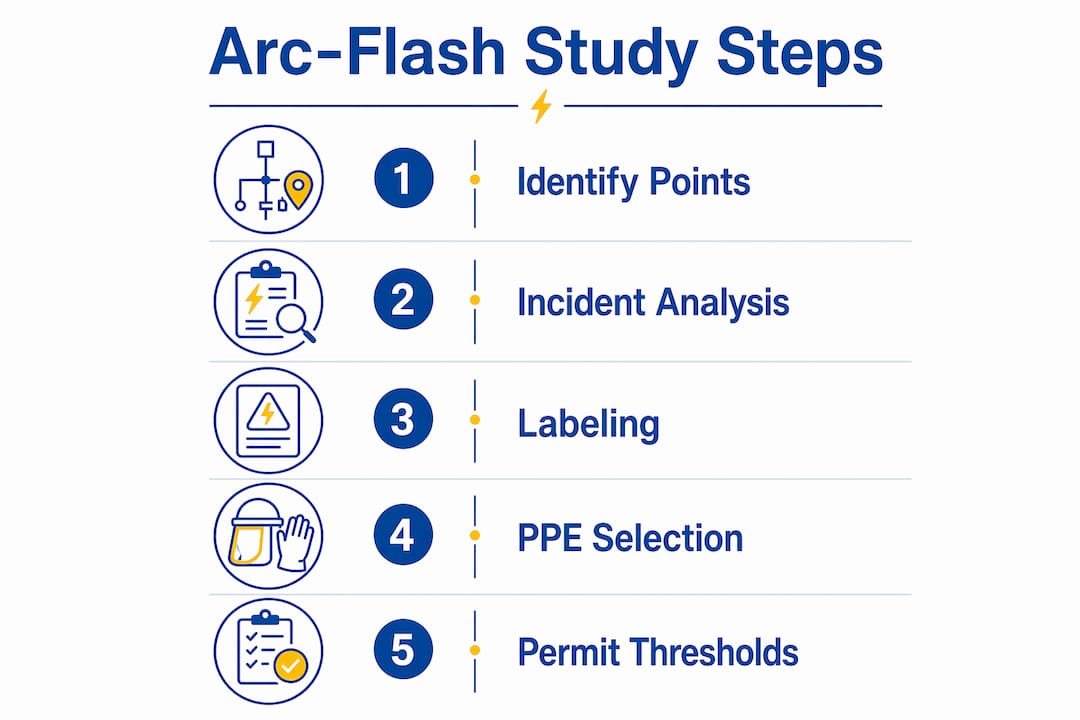
For a data center, the study scope must include every point where a worker could be exposed to arc-flash energy: main switchgear, distribution switchgear, busways, molded-case and low-voltage power circuit breakers, UPS systems, power distribution units (PDUs), distribution transformers, automatic transfer switches, and high-density rack PDUs where applicable. The study models fault current, clearing time, and incident energy at each point, then assigns an arc-flash boundary and PPE category.
Arc-flash studies should be reviewed and updated at least every five years or whenever there are significant changes to the electrical system. In a data center, "significant changes" happens more often than most managers expect.
| Update Trigger | Recommended Action | Required Documentation |
|---|---|---|
| Five years since last study | Full incident-energy analysis | Updated one-line diagram, new arc-flash labels |
| New UPS, ATS, or generator added | Partial or full restudy | Revised one-line, updated labels for affected equipment |
| Utility service change | Full restudy | Updated fault-current data, revised labels |
| Breaker or fuse replacement (different rating) | Partial restudy | Updated protection coordination study |
| Significant load increase (AI/HPC expansion) | Full restudy | Revised one-line, new incident-energy calculations |
| Post-incident review | Targeted restudy | Incident report, corrective action documentation |
The five-year review cycle is a maximum interval, not a target. AI and high-performance computing workloads are driving load changes that alter fault energy levels faster than traditional data center expansions. If your facility has added high-density compute in the last two years, treat that as a system change requiring a restudy.
The study must be performed by a qualified electrical engineer, typically a licensed PE with power systems experience, or a qualified third-party firm. Deliverables include an updated one-line diagram, arc-flash boundary calculations for each equipment location, incident-energy values, PPE category assignments, and arc-flash warning labels that meet NFPA 70E label requirements.
Study outputs drive three downstream decisions: label content, PPE selection, and energized-work permit thresholds. None of those decisions are defensible without a current study.
How do you select PPE and avoid overreliance on it?
PPE selection in a data center starts with the incident-energy analysis. The study assigns a calculated incident energy (in cal/cm²) at each work location. That number determines the minimum arc rating of the PPE required, not a generic category table.
A practical PPE selection flow:
- Pull the incident-energy value for the specific equipment from the arc-flash study.
- Select PPE with an arc rating at or above that value (arc rating = ATPV or EBT, measured in cal/cm²).
- Confirm the full PPE ensemble: arc-rated face shield or arc flash suit hood, arc-rated gloves over rubber insulating gloves, arc-rated clothing, leather work boots.
- Inspect PPE before each use. Damaged arc-rated clothing loses its rating. Rubber insulating gloves require periodic electrical testing per ASTM F496.
- Document PPE assignments by task and equipment location.
The limitation that most programs underestimate: PPE works only when worn correctly, every time, by a worker who is not rushing. Experts warn that PPE reliance assumes perfect human performance; engineering controls that reduce exposure time or eliminate panel access are more reliable than assuming flawless PPE donning under time pressure.
Pro Tip: Run a pre-job briefing before any energized work. Confirm the PPE category, review the energized-work permit, verify the test instrument is rated for the voltage, and walk through the live-dead-live verification sequence. Five minutes of briefing prevents the most common field errors.
Work-practice controls that reduce PPE exposure time include: written justification for energized work (required under NFPA 70E before any live-work permit is issued), pre-job briefings, live-dead-live verification with a properly rated test instrument, and limiting the number of workers inside the arc-flash boundary to those with a direct task.
What maintenance and inspection practices prevent electrical failures?
The shift from time-based to condition-based maintenance is the most significant change in data center electrical-safety practice over the last several years. NFPA 70B (2023) was elevated to a mandatory standard and now explicitly supports continuous monitoring and predictive maintenance approaches, moving beyond fixed calendar intervals.
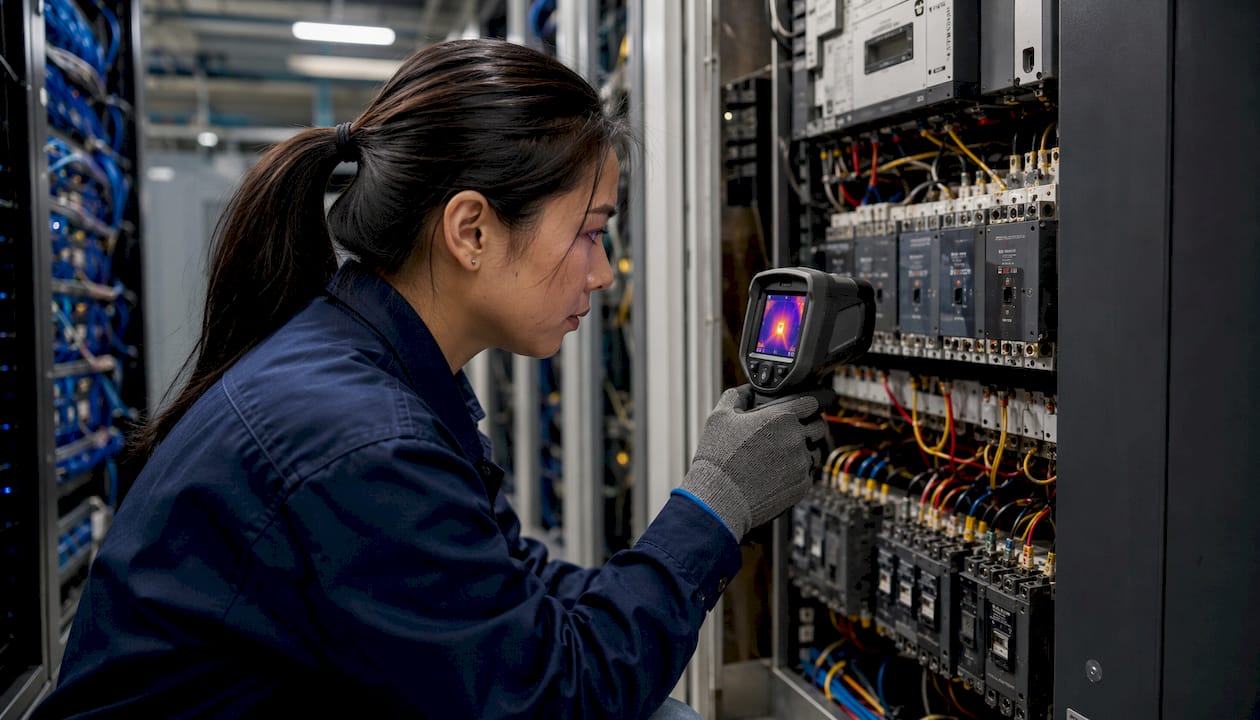
The most common root causes of electrical downtime in data centers are loose connections, overloaded circuits, overheating busbars or cables, UPS battery failure, and breaker or switchgear faults. Condition-based monitoring catches most of these before they become outages.
| Asset | Monitoring Method | What It Detects | Inspection Cadence |
|---|---|---|---|
| Switchgear and MCCs | Closed-panel IR windows + thermal camera | Hot spots, loose connections, overloaded phases | Quarterly thermal scan |
| Busbars and cable trays | Permanent temperature indicators | Sustained overheating trends | Continuous / monthly review |
| UPS systems | Battery impedance testing + thermal | Cell degradation, connection resistance | Semi-annual |
| Breakers (MCCB/LVPCB) | Infrared + trip-time testing | Contact wear, thermal anomalies | Annual or per manufacturer |
| Transformers | Thermal imaging + oil analysis (if applicable) | Winding hot spots, insulation degradation | Annual |
| Generators | Vibration analysis + load bank testing | Mechanical wear, fuel system issues | Semi-annual |
A practical maintenance checklist for data center electrical systems:
- Thermal scan all switchgear and distribution panels quarterly using closed-panel IR windows where installed.
- Test UPS battery strings semi-annually using impedance testing; replace cells that fall outside manufacturer tolerance.
- Inspect and torque all bus connections annually or per manufacturer specification.
- Test breaker trip times annually on critical feeders; document results against manufacturer curves.
- Review condition-monitoring trend data monthly; flag any asset showing a rising temperature trend.
- Maintain a documented maintenance log for every asset, including dates, findings, and corrective actions.
Documented condition history does two things simultaneously: it supports compliance by demonstrating a structured maintenance program, and it gives you the trend data to predict failures before they cause downtime. An undocumented inspection is, from a compliance standpoint, an inspection that did not happen.
Which U.S. standards and regulations apply to data center electrical safety?
The regulatory framework for electrical safety in data centers layers three primary authorities: NFPA 70E, NFPA 70B, and OSHA's electrical-safety regulations. Each covers a different dimension of the program.
NFPA 70E is the primary standard for electrical-safety work practices. It requires a risk assessment before any electrical work, arc-flash labeling on all equipment, a hierarchy of risk controls (with elimination and engineering controls above PPE), and written energized-work permits when live work is justified. It also defines the "qualified person" standard that determines who may perform electrical work.
NFPA 70B (2023) governs electrical equipment maintenance. Now a mandatory standard rather than a recommended practice, it requires documented preventive-maintenance programs and supports condition-based monitoring approaches.
OSHA 29 CFR 1910.331–335 sets the federal electrical-safety-related work practices requirements. These regulations require deenergization as the default, with specific conditions required before energized work is permitted. They apply to all general industry workplaces, including data centers.
OSHA 29 CFR 1910.147 governs the control of hazardous energy, commonly called LOTO. LOTO is the highest-impact compliance risk for data centers, with multi-energy equipment like UPS systems, ATS units, and generators requiring explicit multi-isolation procedures.
OSHA citations for LOTO violations (1910.147) consistently rank among the top ten most-cited standards across all industries. In data centers, the complexity of multi-source equipment makes incomplete LOTO procedures a frequent finding during inspections.
Minimum documentation to keep audit-ready:
- Current arc-flash study and one-line diagram (updated within five years or after system changes)
- Arc-flash labels on all equipment, consistent with study results
- Written LOTO procedures for every piece of multi-energy equipment
- Training records: names, dates, topics, instructor credentials, and competency verification
- Energized-work permits (retained for the duration of the task and archived)
- Preventive-maintenance logs and condition-monitoring records
- Incident and near-miss reports with corrective actions
How do you define 'qualified persons' and build a training program?
Under NFPA 70E and OSHA 1910.331–335, a "qualified person" is someone who has demonstrated skills and knowledge related to the construction and operation of electrical equipment and has received safety training to recognize and avoid the hazards involved. The definition is task-specific: a person may be qualified for one type of work and not another.
That distinction matters in a data center, where the same technician might be qualified to work on low-voltage distribution but not on medium-voltage switchgear. Training programs must address the specific equipment and tasks in your facility.
| Training Type | Audience | Frequency | Deliverables |
|---|---|---|---|
| Initial NFPA 70E qualification | All electrical workers and supervisors | Before first energized-work task | Certificate, competency record |
| Annual refresher | All qualified persons | — | Updated certificate, training roster |
| Task-specific training | Workers assigned new equipment types | Before first task on new equipment | Task-specific competency record |
| Train-the-trainer | Internal safety leads | As needed | Instructor certification, curriculum |
| LOTO-specific training | All workers who perform LOTO | Initial + annual | LOTO competency record |
Instructor credentials matter for two reasons. First, a CSP-credentialed (Certified Safety Professional) or equivalently qualified instructor brings verified competency to the training content. Second, training delivered by credentialed instructors with audit-ready documentation is a high-impact control for demonstrating compliance during an OSHA inspection or insurance audit.
When selecting a training partner, look for:
- CSP or equivalent instructor credentials, verifiable on request
- Curriculum that addresses your specific equipment types (UPS, ATS, high-density PDUs)
- Audit-ready documentation: certificates, training rosters, competency records
- Flexibility in delivery format: onsite, virtual, or train-the-trainer
- Experience with data center environments specifically, not just general industrial training
How do LOTO, energized-work permits, and pre-job planning work in practice?
LOTO in a data center is more complex than in most industrial settings because the equipment has multiple energy sources that must all be isolated. A UPS system, for example, carries AC input, DC bus energy stored in battery strings, and AC output. Isolating only the AC input leaves lethal DC voltage present.
A compliant LOTO procedure for data center equipment must:
- Identify every energy source: AC feeds, DC bus, battery strings, capacitor banks, stored mechanical energy (spring-loaded breakers).
- Notify affected workers and post the equipment as out of service.
- De-energize and isolate each energy source in the correct sequence.
- Apply a personal lock and tag to each isolation point.
- Release or restrain stored energy (discharge capacitors, block spring mechanisms).
- Verify the absence of voltage using a properly rated test instrument: live-dead-live sequence (test on known live source, test the isolated equipment, retest on known live source).
- Document the procedure, the workers involved, and the verification result.
LOTO procedures for data centers must explicitly address stored energy in DC bus capacitors and battery strings, and must include group lockout procedures for multi-isolation equipment like generators, which commonly require six to nine isolation points.
An energized-work permit is required when deenergization is not feasible or creates a greater hazard. The permit must document:
- The specific task and equipment involved
- The justification for energized work (why deenergization is infeasible)
- The incident-energy level and required PPE
- The names of the qualified persons performing the work
- The safety measures in place (barriers, attendants, test instruments)
- Supervisor or safety manager approval
Red flags that should trigger elevated controls or third-party support:
- Incident energy above 40 cal/cm² (the upper limit of standard PPE categories)
- Multi-source equipment with no written LOTO procedure
- Battery string work on large UPS systems
- Work on equipment with no current arc-flash label
- Any task where the worker is uncertain about isolation verification
Why are engineering controls and continuous monitoring now non-negotiable?
AI workloads are changing the risk profile of data center electrical systems faster than most safety programs can track. AI-driven, high-density data centers change load behavior and increase fault energy, making traditional periodic inspections insufficient. A thermal survey conducted quarterly on a facility running conventional server loads may be completely inadequate for the same facility after an AI compute expansion.
The shift is driven by two factors. First, higher rack power densities create larger and more volatile load swings, which stress connections and increase the probability of thermal faults. Second, the fault energy at distribution equipment rises with load, meaning an arc-flash study conducted before an AI expansion may understate the actual incident energy workers face today.
Condition-based monitoring, including permanent thermal indicators, closed-panel IR windows, and trend analytics, now forms the backbone of modern data-center electrical-safety programs, particularly for AI and high-density sites.
Technologies to prioritize:
- Closed-panel thermal imaging windows on all critical switchgear and distribution equipment. These allow thermal surveys under load without removing covers, preserving arc-flash boundaries during inspection.
- Permanent temperature indicators on busbars and high-load connection points. Continuous data catches rising trends between formal surveys.
- Remote switching and racking on critical breakers. Removes the worker from the fault zone for the highest-risk switching operations.
- Trend analytics. Raw sensor data is useful; trended data that flags a connection point rising 5°C over three months is what actually prevents an outage.
The business case is straightforward. Electrical safety is increasingly treated as a business-critical metric tied to uptime and enterprise risk, not just a compliance checkbox. A thermal anomaly caught by a permanent indicator costs a maintenance call. The same anomaly missed costs an outage, potential worker injury, and the regulatory and reputational consequences that follow.
A 90/180/365-day implementation checklist for your electrical-safety program
Building or upgrading a data center electrical-safety program is a phased effort. The sequence below prioritizes actions by risk impact and compliance urgency.
Days 0–90: Assess and stabilize
- Commission an arc-flash study (or verify the existing one is current). Owner: Electrical Manager. Outcome: Current incident-energy values and PPE categories for all equipment.
- Audit all LOTO procedures against actual equipment. Owner: Safety Manager. Outcome: Written procedures for every multi-energy asset, gaps documented and assigned for correction.
- Identify the five highest incident-energy assets and flag for engineering control upgrades. Owner: Electrical Manager. Outcome: Priority list for IR window and test-point installation.
- Verify all arc-flash labels are present, legible, and consistent with study results. Owner: Safety Manager. Outcome: Label audit report; replacement labels ordered.
- Confirm training records are current for all qualified persons. Owner: EHS Manager. Outcome: Training gap list; refresher sessions scheduled.
Days 91–180: Implement controls and training
- Install closed-panel IR windows and permanent test points on the five highest-risk assets. Owner: Electrical Manager / Vendor. Outcome: Reduced exposure during thermal inspections.
- Deliver NFPA 70E training (initial or refresher) to all qualified persons. Owner: EHS Manager / Training Vendor. Outcome: Current certificates and audit-ready training roster.
- Update LOTO procedures to address stored energy and group lockout gaps. Owner: Safety Manager. Outcome: Compliant written procedures for all multi-energy equipment.
- Establish a condition-monitoring schedule: quarterly thermal scans, monthly trend review. Owner: Facilities Manager. Outcome: Documented monitoring program with assigned responsibilities.
Days 181–365: Sustain and improve
- Conduct the first full thermal survey using newly installed IR windows. Owner: Electrical Manager. Outcome: Baseline thermal data for all monitored assets.
- Review and update the arc-flash study if any system changes occurred during the implementation period. Owner: Electrical Manager / PE. Outcome: Current study reflecting actual system configuration.
- Complete annual refresher training for all qualified persons. Owner: EHS Manager. Outcome: Updated training records.
- Conduct an internal compliance audit against NFPA 70E, NFPA 70B, and OSHA 1910.147. Owner: Safety Manager. Outcome: Audit report with corrective actions assigned and tracked.
| Phase | Owner | Effort | Outcome |
|---|---|---|---|
| Arc-flash study (0–90 days) | Electrical Manager | 4 weeks (vendor-led) | Current incident-energy data |
| LOTO audit and update (0–90 days) | Safety Manager | 2–4 weeks | Compliant written procedures |
| Engineering controls (91–180 days) | Electrical Manager / Vendor | 4 weeks | Reduced exposure on high-risk assets |
| NFPA 70E training (91–180 days) | EHS Manager / Trainer | 1–2 days per group | Audit-ready training records |
| Condition-monitoring program (91–180 days) | Facilities Manager | Ongoing | Documented monitoring schedule |
| Full compliance audit (181–365 days) | Safety Manager | 1–2 weeks | Gap report with corrective actions |
Key Takeaways
A defensible data center electrical-safety program requires a current arc-flash study, compliant LOTO procedures, engineering controls that reduce worker exposure, and documented training for every qualified person.
| Point | Details |
|---|---|
| Arc-flash study cadence | Review and update at least every five years, or sooner after any significant system change. |
| LOTO complexity | Data center LOTO must address all energy sources, including DC bus, battery strings, and stored energy in capacitors. |
| Engineering controls first | Closed-panel IR windows, permanent test points, and remote racking reduce exposure before PPE is needed. |
| Training documentation | CSP-credentialed instructors and audit-ready records are the standard for demonstrating qualified-person competency. |
| Arcflashtraining | Arcflashtraining delivers onsite and virtual NFPA 70E training with CSP-credentialed instructors and audit-ready documentation for data center teams. |
A trainer's honest take on where data center programs actually fail
The gap between a written electrical-safety program and a working one is almost always documentation and LOTO application. Facilities invest in arc-flash studies and PPE, then discover during an audit that the LOTO procedures were written for generic equipment, not the actual UPS model on the floor. Or the training records show a class was held but there is no competency verification, no sign-in sheet, and no certificate. Those gaps are what OSHA citations are built from.
The other pattern worth naming: overreliance on PPE as a substitute for engineering controls. A facility that has invested heavily in arc-rated suits but has not installed a single IR window or permanent test point has the risk hierarchy backwards. PPE fails when a worker is in a hurry, when the suit is damaged, or when the gloves are the wrong voltage rating. Engineering controls do not have bad days.
For contractor buy-in, the most effective approach is to require contractors to produce their own NFPA 70E training certificates and LOTO procedures before they touch any electrical equipment. Make it a condition of the work order, not a request. Contractors who cannot produce documentation are not qualified to work in your facility, regardless of what their company letterhead says.
At a training session or audit, the documentation an instructor will expect to see:
- Current arc-flash study with labeled equipment
- Written LOTO procedures for every multi-energy asset
- Training certificates and sign-in sheets for all qualified persons
- Energized-work permits (archived, not just current)
- Condition-monitoring logs with dates and findings
Arcflashtraining brings NFPA 70E compliance to your data center team
Data center electrical-safety programs fail most often not because managers lack knowledge, but because training is generic, documentation is thin, and the instructor has never seen the inside of a critical facility. Arcflashtraining solves that directly.
Arcflashtraining delivers onsite NFPA 70E training led by CSP-credentialed instructors who understand data center environments: UPS isolation, ATS switching, high-density PDU work, and the LOTO complexity that comes with multi-source equipment. Every session produces audit-ready certificates, training rosters, and competency records that hold up to OSHA scrutiny. Virtual instructor-led and train-the-trainer formats are available for teams that need flexibility across multiple sites. If your team needs to get current on NFPA 70E 2027 changes before the next audit cycle, that is covered too. Contact Arcflashtraining to schedule a session for your facility or request a quote for a multi-site program.
Authoritative sources and further reading
The standards and resources below are the primary references for data center electrical-safety compliance and best practice in the United States:
- NFPA 70E: Standard for Electrical Safety in the Workplace — The primary standard governing electrical-safety work practices, arc-flash labeling, risk assessment, and energized-work permits. The NFPA site includes guidance on when an energized-work permit is required.
- OSHA 29 CFR 1910.331–335 and 1910.147 — Federal regulations covering electrical-safety-related work practices and the control of hazardous energy (LOTO). These are the enforcement anchors for OSHA inspections.
- Siemens Data Centers Power Playbook — Covers NFPA 70E and NFPA 70B requirements for data centers, including arc-flash study cadence and condition-based maintenance approaches.
- IRISS: AI Data Centers and Electrical Safety — Practical analysis of how AI workloads change fault energy and risk profiles, with guidance on closed-panel monitoring technologies.
- US Made Supply: Data Center LOTO Procedures — Detailed application of 29 CFR 1910.147 to data center equipment, including multi-source isolation and stored-energy procedures.
- ESFI: Data Center Electrical Safety — Overview of electrical-safety principles for data centers, including qualified worker requirements and NFPA 70B maintenance expectations.
- Wesco: Safety in the Data Center — Broad coverage of data center safety hazards, PPE selection, and compliance with NFPA 70E, 75, 76, and OSHA 1910.
- Graceport: Electrical Safety Trends and Engineering Controls — Industry analysis on the business-risk framing of electrical safety and the case for engineering controls over PPE-first strategies.