
A compliant arc flash study has five non-negotiable elements: a documented electrical hazard risk assessment, incident energy calculations using IEEE 1584 methodology, field labels on all affected equipment, qualified personnel performing the work, and a defined review cycle. OSHA backs this up through 29 CFR 1910.269, which requires employers to estimate heat energy exposure and match PPE to calculated hazard levels. NFPA 70E adds the compliance architecture: arc flash boundary defined by applicable standards, equipment labels showing nominal system voltage, arc flash boundary, and either incident energy or PPE category, plus mandatory periodic review.

Miss any of these, and you don't have a study. You have a liability.
Table of Contents
- What arc flash study requirements actually demand from your team
- The four technical steps of a compliant arc flash study
- How to choose the right PPE selection method
- Managing arc flash risk goes well beyond PPE
- Why professional NFPA 70E training strengthens your compliance program
- Key documentation your arc flash study must produce
- When you need to update your arc flash study
- Common compliance pitfalls that derail arc flash studies
- Key Takeaways
What arc flash study requirements actually demand from your team
The arc flash study requirements under NFPA 70E and OSHA aren't suggestions. Here's what a compliant study must include:
- Documented arc flash risk assessment identifying hazards, estimating likelihood of occurrence, and determining severity of potential injury
- IEEE 1584 incident energy calculations for every piece of equipment likely to be serviced while energized, covering systems from 208 V to 15 kV
- Field labeling on switchboards, panelboards, motor control centers, and similar equipment with nominal system voltage, arc flash boundary, and incident energy or PPE category
- Protective device coordination study to confirm clearing times used in energy calculations are accurate
- Qualified personnel with demonstrated knowledge of IEEE 1584 and NFPA 70E performing or overseeing the work
- Review and update triggers tied to system modifications and a maximum five-year review cycle
OSHA can cite facilities under the General Duty Clause when adequate hazard analysis hasn't been performed, even without a specific arc flash regulation on the books.
The four technical steps of a compliant arc flash study
Every legitimate arc flash study follows the same technical sequence. Skipping a step doesn't save time; it invalidates the results.
-
Data collection. Engineers gather utility fault current data, transformer kVA and impedance, conductor sizes and lengths, breaker and fuse settings, and equipment configurations. Accurate field data is the foundation. Relying on outdated single-line diagrams or assumptions produces incident energy results that are either dangerously low or excessively conservative.
-
Short-circuit study. This calculates available fault current at every node in the system. It's the first mathematical step and determines whether protective devices are rated for the fault currents they may actually see.
-
Protective device coordination study. Engineers review time-current curves and device settings to confirm upstream and downstream devices operate in the correct sequence. Good coordination directly reduces clearing time, which reduces incident energy and improves worker safety.
-
Incident energy calculations. Using IEEE 1584, engineers calculate incident energy in cal/cm² at each equipment location and define the arc flash boundary at the working distance. These numbers drive every label, every PPE decision, and every safe work procedure that follows.
IEEE 1584.1 provides additional guidance on scope and deliverable requirements, making it worth referencing explicitly in any engineering contract.
How to choose the right PPE selection method
NFPA 70E defines two methods for selecting arc flash PPE, and they are mutually exclusive. You pick one per piece of equipment. Mixing them on the same equipment is not permitted.
- Incident Energy Analysis Method: Engineers calculate the specific incident energy at each location. Workers select PPE with an arc rating at or above that value. This method is equipment-specific and precise, which is why electrical safety experts consistently prefer it.
- Arc Flash PPE Category Method: Uses tables in NFPA 70E to assign a PPE category (1 through 4) based on equipment type, estimated fault current, and clearing time. Faster to apply, but often conservative, and it has limits. If available fault current exceeds the table's maximum, or clearing time is longer than the table allows, incident energy analysis is required regardless.
The practical takeaway: incident energy analysis gives you defensible, equipment-specific numbers. The category method is a shortcut with defined boundaries. Know which situation you're in before choosing.
Managing arc flash risk goes well beyond PPE
PPE is the last line of defense, not the first. The 4P risk management framework structures this correctly.
- Predict: Quantify arc flash hazards through incident energy calculations. You can't control what you haven't measured.
- Prevent: Apply engineering controls first. Arc flash mitigation relays, current-limiting fuses, and zone-selective interlocking all reduce incident energy before a worker ever puts on a face shield.
- Process: Develop and enforce safe work procedures, energized work permits, and job briefing requirements. Administrative controls reduce the likelihood that a worker is ever exposed to the hazard.
- Protect: When the first three steps leave residual risk, PPE addresses it. Properly applied, it limits incident energy at the skin to 1.2 cal/cm², the threshold for onset of a second-degree burn.
Qualified personnel are central to every layer. Training isn't a compliance checkbox; it's what makes the other three Ps function in the field.
Why professional NFPA 70E training strengthens your compliance program
Knowing the requirements and executing them consistently are two different things. Professional NFPA 70E training and certification closes that gap.
- Instructors credentialed as Certified Safety Professionals (CSPs) teach the standard as it applies to real industrial and commercial systems, not just theory.
- Training covers hazard awareness, PPE selection, lockout/tagout procedures, and approach boundaries, giving workers the knowledge to apply study results correctly on the floor.
- Audit-ready documentation comes with every session, which matters when OSHA shows up.
- Onsite training can be customized to your facility's specific equipment, voltage classes, and work tasks, making the content immediately applicable.
- Virtual instructor-led and multi-site formats give facility managers flexibility without sacrificing the rigor of live instruction.
Key documentation your arc flash study must produce
A completed study isn't just a report. Compliance requires a specific set of deliverables.
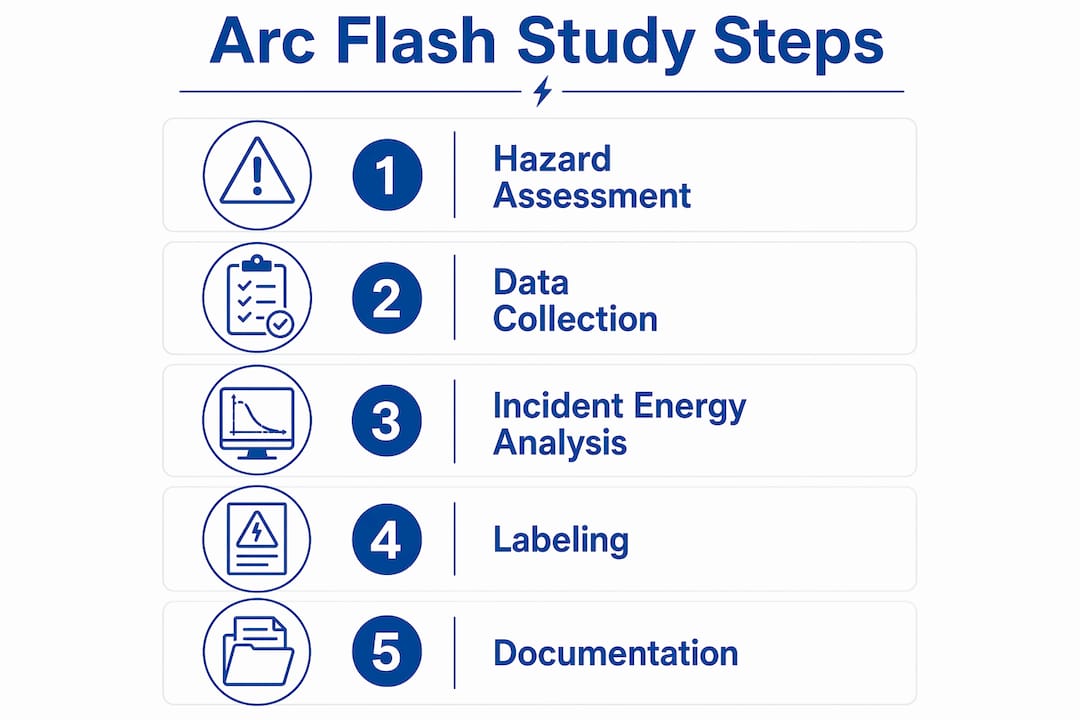
The study package should include updated single-line diagrams reflecting actual field conditions, a system input data table, short-circuit calculation results, device coordination curves and settings, incident energy values at each equipment location, arc flash boundary distances, and PPE requirements per location. Field labels must be installed and visible. Both the arc flash risk assessment and the shock risk assessment must be documented separately per NFPA 70E sections 130.4(D) and 130.5(D). A written electrical safety program, energized work permits, and pre-job briefing checklists round out the compliance record.
When you need to update your arc flash study
The five-year review cycle gets most of the attention, but system changes are the more common trigger. Update the study when any of the following occur:
- Utility changes transformer sizing or fault current contribution
- New equipment is installed or existing equipment is removed
- Breaker settings or protective device types are modified
- Loads are added that change available fault current at downstream equipment
- A scheduled five-year review interval is reached
Labels must be updated promptly after any reassessment. Outdated labels are a compliance failure and a safety hazard.
Common compliance pitfalls that derail arc flash studies
Most compliance failures come down to a handful of recurring mistakes.
Stale field data is the most common. Studies built on outdated panel schedules or unverified breaker settings produce inaccurate incident energy values. Field verification isn't optional. Skipping coordination studies is a close second. Without confirmed clearing times, incident energy calculations are guesswork. Mixing PPE selection methods on the same piece of equipment violates NFPA 70E directly. Failing to update after system changes turns a once-compliant study into a liability. And undertrained workers who can't interpret labels or apply PPE correctly undermine every engineering control upstream of them.
The arc flash compliance resources at Arcflashtraining cover these issues in depth for facility teams navigating NFPA 70E for the first time or managing a multi-site program.
A compliant arc flash study requires IEEE 1584 calculations, NFPA 70E documentation, and trained workers who can apply the results correctly in the field.
Key Takeaways
| Point | Details |
|---|---|
| Five mandatory elements | Every compliant study needs a documented risk assessment, IEEE 1584 calculations, field labels, qualified personnel, and a review cycle. |
| Five-year review maximum | NFPA 70E requires reassessment at intervals not exceeding five years, or sooner after any system change. |
| PPE is last resort | The 4P framework prioritizes prediction, prevention, and process controls before PPE enters the picture. |
| Two PPE methods, not both | Incident Energy Analysis and the PPE Category Method are mutually exclusive per piece of equipment under NFPA 70E. |
| Documentation is compliance | Both shock and arc flash risk assessments must be separately documented; labels, permits, and a written safety program are also required. |