
What is an arc flash risk assessment?
An arc flash risk assessment is a systematic process to identify electrical hazards, estimate the likelihood and severity of an arc flash incident, and determine the protective measures workers need before approaching energized equipment. Under NFPA 70E Section 130.5, every employer whose workers may be exposed to electrical hazards is required to conduct one. OSHA reinforces this under 29 CFR 1910.333, treating NFPA 70E as the guiding standard for compliance.
The assessment produces three critical outputs:
- Arc flash boundary: the distance from an energized source at which incident energy reaches 1.2 cal/cm², the threshold for second-degree burns
- Incident energy at working distance: the thermal energy, measured in cal/cm², a worker's face and chest would be exposed to during an arc event
- PPE requirements: the arc-rated clothing and equipment category needed for any permitted energized work within that boundary
Beyond PPE, arc flash incidents represent a significant share of workplace electrical fatalities, making a professional hazard assessment the foundation of any serious electrical safety program. NFPA 70E also requires that shock hazard boundaries (limited and restricted approach) be assessed alongside arc flash boundaries, so the two risk assessments run together, not separately.
Table of Contents
- Core standards and methods that govern arc flash assessments
- Why a thorough assessment does far more than select PPE
- How assessment findings should drive your training program
- Common pitfalls that undermine arc flash assessments
- What effective arc flash assessment implementation looks like in practice
- Arcflashtraining brings NFPA 70E compliance within reach for your team
- Key Takeaways
Core standards and methods that govern arc flash assessments
Two standards do the heavy lifting here: NFPA 70E sets the safety requirements and work practice rules, while IEEE 1584-2018 provides the mathematical models for calculating incident energy and arc flash boundaries across three-phase AC systems from 208 V to 15 kV.
Before any arc flash calculation begins, two foundational studies must be completed:
- Short-circuit study: verifies that all equipment is properly rated to interrupt available fault current; underrated devices can fail catastrophically during an arc event
- Protective device coordination study: confirms that breakers, fuses, and relays will operate in the correct sequence and time frame
One counterintuitive finding shapes both studies: lower short-circuit current systems can actually produce higher incident energy levels because protective devices take longer to clear the fault. Faster clearing time means dramatically less energy released. A real-world example illustrates this precisely: reducing a 480 V MCC's MCCB short-time delay from 0.3 s to 0.1 s drops incident energy by roughly 57% and moves the required PPE down a full category.
For PPE selection, NFPA 70E and IEEE 1584 permit exactly two methods, never used simultaneously on the same piece of equipment:
- Incident energy analysis method: calculates actual cal/cm² exposure at the working distance using IEEE 1584 equations; produces equipment-specific labels
- Arc flash PPE category method: uses lookup tables based on equipment type, maximum fault current, and clearing time to assign one of four PPE categories
Pro Tip: Software tools can generate arc flash results with errors that require expert review. Competent electrical engineers should verify all outputs before labels are printed and affixed to equipment.

Why a thorough assessment does far more than select PPE
Safety managers sometimes treat the arc flash study as a one-time PPE-selection exercise. That misses most of its value. Accurate system data and comprehensive studies enable engineering controls that reduce hazard severity at the source, which is always preferable to relying on PPE alone.
The broader benefits of a well-executed assessment include:
- Protective device coordination improvements: adjusting relay settings or replacing slow-clearing devices can cut incident energy significantly without touching the electrical load
- Maintenance scheduling: the study reveals which breakers and fuses are most critical to arc flash outcomes, prioritizing them for testing and servicing
- Equipment replacement decisions: panels operating above 40 cal/cm² should not have energized work performed on them at all; the study surfaces those locations before someone gets hurt
Proper equipment maintenance is the most effective preventative control for reducing arc flash likelihood. A breaker that fails to trip per its time-current curve can turn a manageable arc event into a catastrophic one for anyone working downstream.
Many organizations no longer employ dedicated in-house electrical engineers, which means the data underlying their arc flash labels may be years out of date. Periodic professional reassessment is not optional when system changes, equipment additions, or utility supply modifications have occurred. NFPA 70E requires the incident energy analysis to be reviewed at intervals not exceeding five years, and immediately after any change that could affect results.
How assessment findings should drive your training program
An arc flash risk assessment tells you what the hazards are. Training tells your workers what to do about them. NFPA 70E requires that employees exposed to electrical hazards receive training on safe work practices, PPE selection, and the specific hazards present in their work environment.
Effective training programs built on assessment findings cover:
- PPE selection and donning: workers must understand which category applies to each piece of equipment they service, not just that PPE exists
- Lockout/tagout (LOTO) procedures: the safest arc flash calculation is the one never needed because equipment was verified de-energized before work began
- Energized work permits: NFPA 70E 130.2 requires written authorization for energized work above 50 V, documenting the hazards, justification, and safe work practices
- Shock and arc flash boundary recognition: workers need to identify both sets of boundaries in the field, not just on a label
Training format matters for retention and reach; consider an Arbeitsschutz Schulung online resource to enhance safety training effectiveness. Onsite training lets instructors walk the actual facility floor, reference real equipment labels, and address site-specific hazards directly. Virtual instructor-led courses extend that same quality to multi-site organizations without the travel cost. Train-the-trainer programs build internal capacity for ongoing refresher delivery. Whichever format fits, audit-ready documentation and certification records are non-negotiable for OSHA compliance.
Common pitfalls that undermine arc flash assessments
Even well-intentioned assessments fail when execution breaks down. The most frequent problems:
- Stale data: electrical systems change constantly. New equipment, utility upgrades, and load additions all affect incident energy calculations. Labels printed five years ago may now be dangerously wrong.
- Mixing PPE selection methods: using the incident energy analysis result to look up a PPE category in the arc flash PPE category table is explicitly prohibited by NFPA 70E. Pick one method per piece of equipment and apply it correctly.
- Ignoring reduced arcing current scenarios: IEEE 1584-2018 requires checking incident energy at both the calculated arcing current and a reduced value (typically 85% for low-voltage systems) to capture worst-case exposure. Skipping this step can underestimate hazard levels.
- Treating PPE as the primary control: PPE is the last line of defense. Engineering controls, administrative controls, and de-energizing equipment always take priority in the hierarchy of risk control.
- No documentation: both shock and arc flash risk assessments must be documented per NFPA 70E Sections 130.4(D) and 130.5(D). Missing records create compliance exposure during OSHA audits.
What effective arc flash assessment implementation looks like in practice
A worked example from a 480 V motor control center (MCC) in a petrochemical facility demonstrates how the process translates from calculation to real protection. Starting with a bolted fault current of 22 kA and an 800 A MCCB with a 0.3 s short-time delay, the IEEE 1584-2018 calculation yields an incident energy of 12.8 cal/cm² at an 18-inch working distance. That result requires PPE Category 3: arc-rated coveralls rated at minimum 25 cal/cm², arc-rated face shield, hard hat with arc-rated balaclava, and arc-rated gloves. The arc flash boundary calculates to 1.94 meters, meaning anyone within that distance during an arc event would sustain second-degree burns without proper PPE.
The more instructive finding: reducing the MCCB short-time delay from 0.3 s to 0.1 s drops incident energy to 5.5 cal/cm² and moves the required PPE down to Category 2. That single relay setting change, verified through a protection coordination study, delivers more worker protection than any PPE upgrade. This is exactly the kind of engineering control that a thorough arc flash study surfaces and that a PPE-only approach would never find.
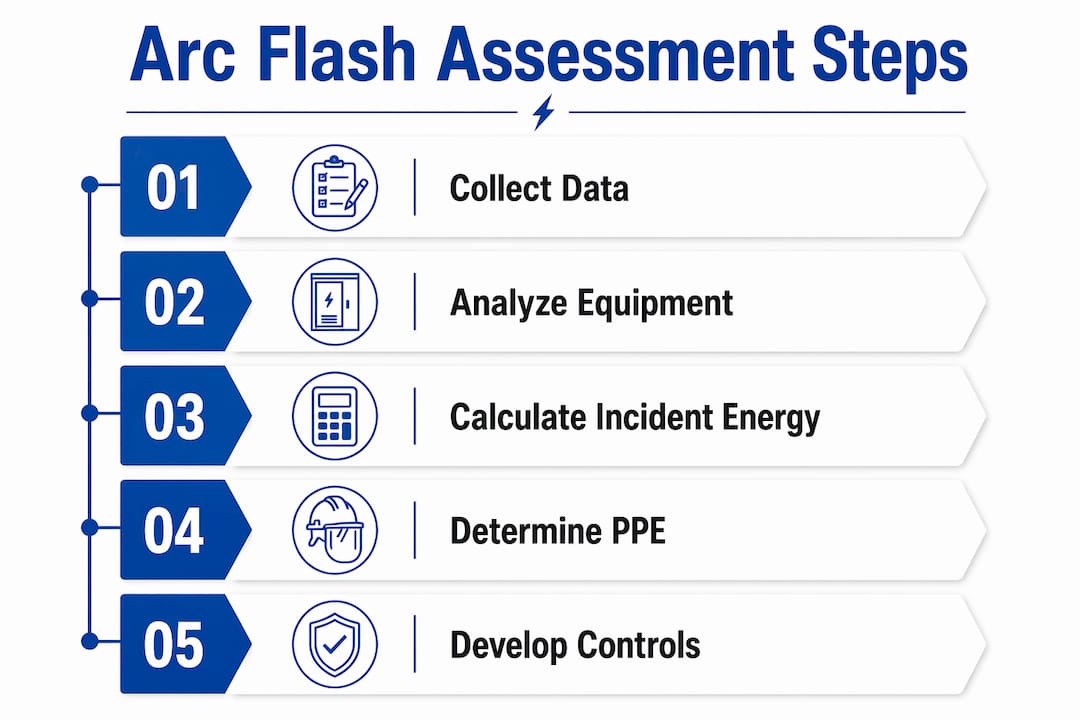
For organizations running their first assessment, the arc flash analysis checklist should include: field data collection, one-line diagram development, short-circuit study, protective device coordination review, IEEE 1584 incident energy calculations, equipment labeling, and a training update tied to the new label data.
Arcflashtraining brings NFPA 70E compliance within reach for your team
Completing an arc flash risk assessment is step one. Getting your workforce trained on what it means is where most organizations stall.
Arcflashtraining delivers nationwide NFPA 70E electrical safety training in the format that fits your operation: onsite at your facility, live virtual instructor-led sessions, custom multi-site programs, and train-the-trainer options that build lasting internal capacity. Every course is led by CSP-credentialed instructors and includes certification and audit-ready documentation your compliance team can hand to an OSHA inspector without hesitation. Clients range from Fortune 500 manufacturers and utilities to data centers and healthcare systems. Contact Arcflashtraining to schedule a session or get a quote for your team.
Key Takeaways
A complete arc flash risk assessment, built on current system data and NFPA 70E methodology, is the only reliable foundation for both worker protection and regulatory compliance.
| Point | Details |
|---|---|
| Two methods, never mixed | NFPA 70E permits incident energy analysis or the PPE category method per equipment, never both simultaneously. |
| Clearing time drives energy | Reducing a 480 V MCC's short-time delay from 0.3 s to 0.1 s cuts incident energy by roughly 57%. |
| Reassess every five years | NFPA 70E requires incident energy analysis review at intervals not exceeding five years, and after any system change. |
| Maintenance is the top control | Proper equipment maintenance is the most effective preventative control for reducing arc flash incident likelihood. |
| Arcflashtraining | Provides CSP-led, audit-ready NFPA 70E training nationwide in onsite, virtual, and multi-site formats. |