
What NFPA 70E arc flash label requirements actually demand
Every arc flash label on non-dwelling electrical equipment in the U.S. must carry four specific data elements. Get any one of them wrong, and the label is non-compliant, full stop. The 2026 NEC 110.16 codified these requirements explicitly, closing the loophole that once allowed generic "WARNING: Arc Flash Hazard" stickers to pass inspection.
The four mandatory elements under the updated NEC, aligned with NFPA 70E Section 130.5(H), are:
- Nominal system voltage — the operating voltage of the equipment
- Arc flash boundary — the distance (in feet and inches) at which an unprotected worker would sustain a second-degree burn
- Available incident energy or minimum PPE level — either the calculated incident energy in cal/cm² at the working distance, or the arc flash PPE category (1 through 4 per NFPA 70E Table 130.5(G)); never both on the same label
- Date of the arc flash hazard assessment — when the underlying study was completed
These labels must be permanently affixed and visible to qualified personnel without removing covers or opening enclosure doors. OSHA does not publish its own arc flash labeling standard; instead, it references NFPA 70E as the recognized industry consensus when evaluating facility compliance. IEEE 1584 governs the calculation methodology behind the incident energy values that appear on those labels.
The shift from generic warning labels to study-backed, calculated data is not cosmetic. A label that says "Arc Flash Hazard — Wear PPE" tells a worker almost nothing actionable. A label showing 8.4 cal/cm² at 18 inches, with a 42-inch arc flash boundary, tells them exactly what suit to put on and where to stand.
Table of Contents
- What goes on the label and how durable it needs to be
- When labels must be updated and what triggers a review
- How arc flash labeling fits into your Electrical Safe Work Policy
- Common label types and formats used in the field
- Where to place labels and how large they need to be
- Key Takeaways
- Why labeling compliance is more urgent than most facilities realize
What goes on the label and how durable it needs to be
Beyond the four NEC-mandated fields, a fully compliant NFPA 70E label typically includes additional data that makes it genuinely useful at the point of work:
- Working distance — the assumed distance between the worker's face and the arc source used in the incident energy calculation
- Equipment identification — panel number, equipment tag, or machine name to confirm the label matches the equipment
- Shock hazard information — limited and restricted approach boundaries, though not strictly required by NFPA 70E, are standard practice and strongly recommended
- Arc flash PPE category or incident energy — one or the other, calculated per IEEE 1584 or selected from NFPA 70E tables, never both
On material and durability: labels must withstand the environmental conditions of the facility and remain legible for the life of the equipment. In industrial settings, that means resistance to moisture, UV exposure, chemical splash, and abrasion. Thermal transfer polyester, laminated vinyl, and engraved phenolic are the materials that hold up. Paper labels or standard adhesive stock will not survive a switchgear room.
Handwritten labels are not permitted except for information subject to frequent change. All permanent label data must be professionally printed for legibility and durability.

Pro Tip: The date printed on the label must reflect when the arc flash study was completed, not when the label was printed or applied. An inspector who sees a label dated three years ago will check whether a system modification occurred since then. If it did and the label was not updated, you have a violation regardless of how clean the label looks.
Labels belong at eye level on the equipment's access point or enclosure door. If a panel has multiple access doors, each one needs its own label. The goal is that a qualified worker can read the label before opening anything.
When labels must be updated and what triggers a review
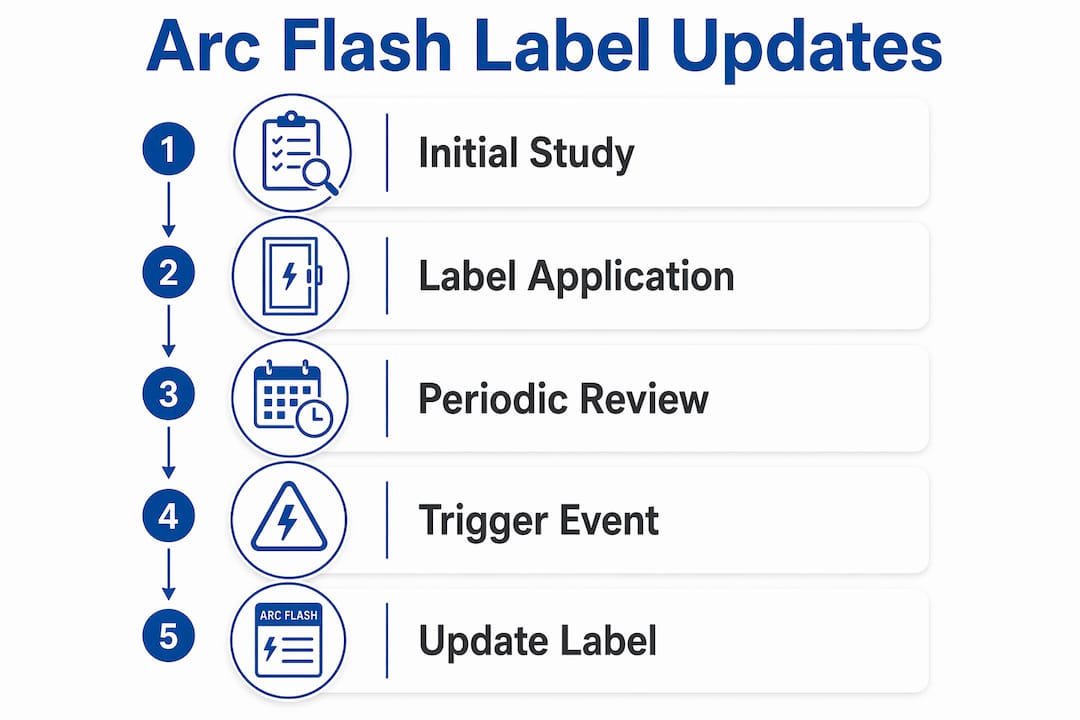
Arc flash labels are not a one-time installation. NFPA 70E requires arc flash risk assessments to be reviewed at intervals not exceeding five years. Any label older than five years without a documented reassessment is non-compliant, regardless of how legible or physically intact it appears.
Several events require an immediate label update before the five-year mark:
- New or replaced transformers that change available fault current at downstream equipment
- Utility service changes affecting short-circuit current levels
- Added or reconfigured protective devices such as new breakers, fuses, or relays that alter clearing times
- Significant load additions that change system impedance and arc flash energy levels
- Changes to bus configuration or switching arrangements in switchgear or MCCs
The practical implication: your electrical safety team needs a change-management process that flags any of these events and triggers a label review. A label that was accurate in 2021 may be dangerously wrong after a 2024 transformer replacement if no one updated the study.
Procedurally, coordinate label updates between your electrical engineering team (who runs the arc flash study), your safety team (who manages the labeling program), and your maintenance team (who works near the equipment). Labels should be replaced, not covered or written over, when updated data is available.
How arc flash labeling fits into your Electrical Safe Work Policy
An arc flash label is a communication tool, not a compliance checkbox. Its real function is to give qualified workers the information they need to select the right PPE, establish the right boundaries, and decide whether energized work is even permissible. That function only works when the label is embedded in a broader Electrical Safe Work Policy (ESWP).
A complete ESWP integrates four elements, and labeling supports all of them:
- Documentation — arc flash studies, one-line diagrams, and equipment records that back every label's data
- Safe work procedures — written procedures for energized work that reference label data for PPE selection and boundary establishment
- Lockout/tagout (LOTO) coordination — labels identify when de-energization is required; LOTO procedures execute it
- Training — workers must know how to read and act on label data, not just acknowledge its presence
Training is where labeling programs most often break down. A label showing "PPE Category 3" means nothing to a worker who has not been trained on NFPA 70E PPE categories and what arc-rated gear Category 3 requires. CSP-credentialed instructors who deliver NFPA 70E training cover label interpretation as a core competency, connecting the printed data to actual PPE selection decisions in the field.
One hard limit worth knowing: when incident energy exceeds 40 cal/cm², energized work is prohibited under normal protocols. The label is the mechanism that communicates this boundary. If workers cannot read and act on that number, the label provides no protection.
Local electrical inspectors now treat labeling accuracy as a primary compliance indicator during routine facility audits, not just a post-incident concern. Accurate, current labels signal a facility that manages its electrical safety program proactively.
Common label types and formats used in the field
Arc flash labels are not standardized in appearance, but several formats have become industry norms:
Incident energy labels display the calculated cal/cm² value, working distance, arc flash boundary, and system voltage. These require a site-specific arc flash study per IEEE 1584 and are the most precise option. They are the default for complex or high-energy systems.
PPE category labels use the table-based method from NFPA 70E, displaying a category number (1–4) rather than a calculated energy value. They are faster to produce and appropriate where the table conditions apply, but they cannot be used when the equipment falls outside the table parameters.
ANSI Z535-format labels use color-coded headers: orange for "WARNING" (serious injury or death possible) and red for "DANGER" (most extreme hazards). This format aligns with OSHA's accident prevention sign requirements and is widely used to meet both NFPA 70E and OSHA signage standards simultaneously.
Combination labels include both arc flash and shock hazard data on a single label, covering limited and restricted approach boundaries alongside arc flash boundary and PPE data. These are common on switchgear and MCCs where both hazard types are present.
Most facilities use thermal transfer-printed polyester labels in a standard 3.5" × 5" or 4" × 6" format, though size is not mandated by NFPA 70E as long as all required data is legible.
Where to place labels and how large they need to be
NFPA 70E does not specify a minimum label size, but it does require that labels be visible to qualified workers without removing covers or opening enclosure doors. That requirement drives placement decisions more than any dimension rule.
Best practices that hold up under inspection:
- Eye level on the primary access point — typically the front door or cover of a panel, switchboard, or MCC bucket
- One label per access point — if a switchgear lineup has six sections, each section door gets its own label with section-specific data
- Not inside the enclosure — a label mounted on the interior of a door panel is non-compliant if the door must be opened to read it
- Away from hinges and latches — labels placed where they will be folded, scratched, or obscured by hardware fail the legibility standard quickly
- Replacement, not layering — when a label is updated, the old label comes off; stacking a new label over an old one creates confusion and is not acceptable
Size should be large enough to read from a normal standing position without leaning in. In practice, 3.5" × 5" is the minimum that accommodates all required data fields in a legible font. High-energy equipment with more data fields often warrants a 4" × 6" label.
Key Takeaways
NFPA 70E arc flash label requirements mandate specific calculated data on every label, and labels older than five years or affected by system changes are non-compliant regardless of physical condition.
| Point | Details |
|---|---|
| Four mandatory NEC fields | Every label must show system voltage, arc flash boundary, incident energy or PPE level, and assessment date. |
| Five-year review cycle | Arc flash risk assessments must be reviewed at least every five years or after any major system modification. |
| 40 cal/cm² hard limit | When incident energy exceeds 40 cal/cm², energized work is prohibited under normal protocols. |
| Study date, not print date | The label date must reflect when the arc flash study was completed, not when the label was applied. |
| Labeling within the ESWP | Labels only protect workers when paired with training, LOTO procedures, and documented safe work practices. |
Why labeling compliance is more urgent than most facilities realize
The enforcement landscape has shifted. Arc flash labeling used to be something inspectors noted after an incident. Now local electrical inspectors treat label accuracy as a leading indicator of a facility's overall electrical safety culture, checking it during routine audits before anything goes wrong.
What that means practically: a missing label, an outdated study date, or a label that shows PPE Category 2 on equipment that now runs at higher fault current is not just a paperwork problem. It is evidence that the facility's electrical safety management system has a gap. Inspectors draw that conclusion quickly, and citations follow.
The most common labeling failures found during inspections are not dramatic. They are mundane: labels applied after a 2019 study that was never refreshed after a 2022 transformer upgrade; labels on the inside of enclosure doors that require opening the panel to read; PPE category labels on equipment where the table conditions no longer apply because the system changed. None of these require sophisticated analysis to catch. They require a labeling program that treats labels as living documents tied to a maintained arc flash study, not as permanent fixtures installed once and forgotten.
Facility managers who embed labeling into their change-management process, and who train their teams to interpret label data correctly, are the ones who pass inspections without scrambling. The label is the front line of electrical hazard communication. Treat it that way.